


Every step matters
We spend each day looking for new and better ways to care – for people, and for the planet. Our mission with the TENA Protects Program is to make better choices, acknowledging what we leave behind matters and recognizing that every action we take today can contribute to a healthier planet tomorrow.
Social Responsibility – improving well-being everyday
TENA products help people to live happier, fuller lives. Our high-quality products have already increased hygiene and health standards for millions of users and caregivers. Social responsibility is about caring and daring to act boldly on social issues that others fear to champion. We're innovating smarter designs such as TENA® SmartCare and TENA Stylish™ Washable Absorbent Underwear.
We work hard to increase awareness and improve care services around the world by sharing our knowledge in hygiene and health and by promoting an open dialogue to help break down the stigma associated with incontinence.
As a global leader in adult urinary incontinence products, we’re focused on where we can have meaningful impact by, for example, using responsibly sourced pulp in our products and recycled content in our polyethylene bags.
Environmental Responsibility – better solutions with lower carbon footprint
We’re continually discovering and innovating and finding new ways to help improve people’s lives while also helping to improve our products’ environmental footprint. We want to design products and services where less goes to waste and more is recycled and reused while driving sustainable continence care management. It’s all about doing more with less.
Responsibly sourced pulp –The Program for the Endorsement of Forest Certification*
 |
As a leading global alliance of national forest certification systems, the organization is dedicated to promoting sustainable forest management through independent 3rd party certification. All TENA® absorbent incontinence products produced in our North American production facilities use PEFC-certified pulp and such sites are FSC and PEFC chain of custody certified. This means all pulp suppliers are FSC Chain-of-Custody certified and deliver at least FSC Controlled Wood to Essity. The pulp we purchase is audited according to our Global Supply Standard. A smaller part is coming from FSC Certified forests, the rest is coming from FSC Controlled sources. Certification is key in order to provide evidence of sustainable forest management by giving forest owners the ability to demonstrate that they are using sustainable practices. |
*Our US and Canadian manufacturing sites are FSC and PEFC chain of custody certified.
Sustainable packaging
We’ve been taking steps to make every TENA® product packaging and product more sustainable with the goal of reducing our carbon footprint. A Life Cycle Assessment (LCA) studies the potential environmental impact of products and product packaging throughout its life cycle. LCAs help us identify ways to reduce a product’s environmental impact to help improve its carbon footprint, such as using recycled material in our TENA® polyethylene packaging.*
Starting in 2024, TENA® absorbent incontinence product bag packaging will begin the transition to incorporating packaging materials from post-consumer recycled material.
*Each polyethylene bag/pack containing recycled materials will specify the percent of recycled materials directly on the bag or packaging.
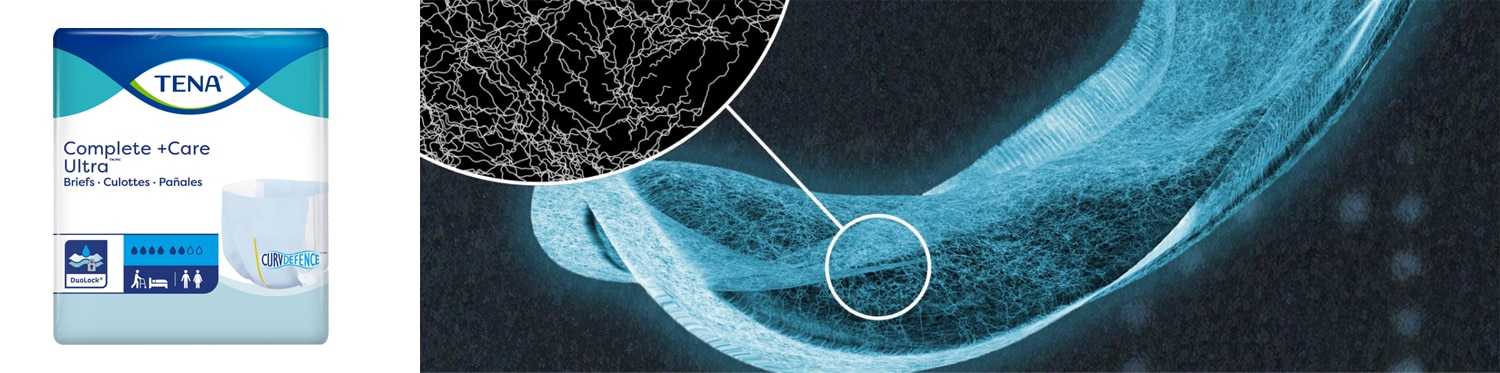
The life cycle of a TENA® product has several stages
including transportation, use and after-use management
Apart from use, these stages help contribute to a percentage of a product’s carbon footprint. Here's a look at what we are doing to help lower our emissions in each stage:

Transportation - Improve logistics
At our manufacturing facilities in the US and Canada, excess recycled materials from production lines are compressed before being transported, which means more material & weight per truckload thus reducing the number of truckloads to transport those excess materials. The excess recycled materials at those manufacturing sites are then shipped to a recycling facility vs. going into a landfill.

Usage - Sustainable solutions
Creative solutions, such as TENA Stylish™ Washable Absorbent Underwear and TENA® Smart Care, to help reduce consumption of disposable incontinence products
After-use Management - Improve circularity
Working to ensure TENA® polyethylene bags for TENA absorbent products are recyclable or contain some recycled materials.

A new level of transparency
We care about what goes into the products you wear and the impact they have on the planet. To give you a better idea, here’s a breakdown of the key components for incontinence products. You can also find the carbon footprint of most TENA® products at the EPD International website, as a downloadable Environmental Product Declaration.
Product Core
The middle of the product where urine is absorbed and stored and consists of three parts:
- Acquisition Layer –Transports liquid away from skin to the product’s absorbent core where it’s stored. Materials consist of synthetic fibers.
- The Big Core & the Small Absorbent Core –The innermost layer, consisting of paper pulp, sometimes in combination with super-absorbent polymers and / or other paper-based materials. This layer traps and stores urine to help keep the wearer dry.
Product chassis
The shell of the product designed to hold the core together to help create a proper fit for the wearer which consists of two parts:- Top Sheet –This material helps keep your skin dry and comfortable by absorbing liquid. It’s composed of materials made of polypropylene, polyethylene, polyester or viscose.
- Back Sheet – A water-resistant outer layer made of polypropylene, polyethylene, polyester or viscose. Its purpose is to help prevent liquids from leaking through onto the wearer's clothing.

Additional materials
Small amounts of adhesives are used in the core and the chassis, and some products feature prints.
- Adhesive - Made from various polymers and synthetic resins.
- Fit and Comfort Features - Fastening materials and elastic materials made of polymers help keep the product in place.
Packaging
- Release paper - Protects the adhesive part of the product prior to use and is made of silicone-coated paper.
- Single pack - Some products come wrapped in a polyethylene film which is sometimes silicone-coated. Single packs protect the product so that you can carry them around without getting them dirty.
- External product packaging - Consisting of a polyethylene bag or box, it contains and protects the product. This is the package you see on store shelves.
Glossary
Polymers
Large-chain molecules that can be either natural or synthetic. For instance, plastic as well as your DNA consist of polymers.
Polypropene / polyethylene / polyester
Some of the world's most common plastic types. Used in a wide range of everyday products, from underwear to blankets.
Super-absorbent polymer (SAP)
Used for its moisture-retaining properties. Commonly used in pads, diapers and compresses.
Synthetic resin
Viscous liquids that harden quickly making them ideal for binding materials together.